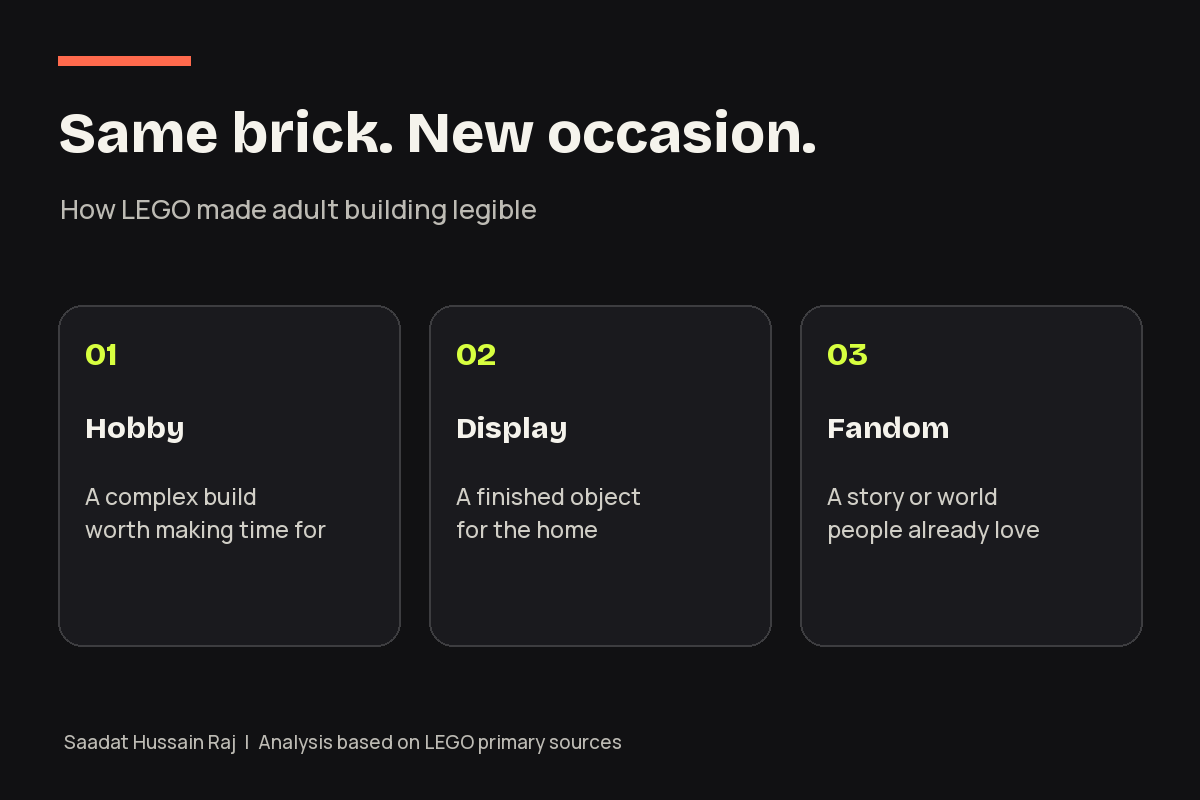
LEGO did not need to invent an adult version of the brick. It needed to make adult reasons to build visible.
That distinction explains one of the more interesting audience expansions in consumer branding. The product’s core action stayed the same: select pieces, follow or depart from a plan, build something tangible. The purchase occasion changed. A parent buys a set for a child; an adult might buy a long project, a display object, a gift, or a familiar fictional world. LEGO built clearer paths to each of those uses without making play feel like a children’s leftover.
This is an analysis of public company material, not an inside account of campaign decisions. LEGO’s Adults Welcome destination, 18+ catalog, Botanicals announcements and 2025 results show what the company put in front of customers. They do not isolate how much revenue any single message caused.
The old category boundary was the occasion
A brick has no age limit. Retail shelves, gift habits and the way toys are discussed often do. When a brand is strongly associated with childhood, an adult buyer needs a socially legible reason to buy for themselves. LEGO did not answer that with a lecture about why adults may play. It created visible reasons that look natural in adult life.
Its adult shop groups products around interests such as art, music, travel, science, vehicles and entertainment. The page talks about unwinding and finding a build that suits a passion. These are not merely demographic labels. They connect the same building action to an occasion an adult already recognizes: a quiet evening, a collectible, a shared fandom, a designed object for a shelf.
Three doors into the same brand
First, building as a hobby. The Find Your Flow destination presents building as a way to slow down and focus. The offer is time with a physical task, not a claim that the bricks have transformed into a different product.
Second, building as display. LEGO Botanicals makes the finished object part of the value. In its November 2024 announcement, the company described Botanicals as a distinct theme from 2025 and explicitly linked it to adult creativity, relaxation and home display. The original building behavior still matters; the resulting arrangement earns a place in a room where a toy might not.
Third, building as fandom. The 18+ assortment includes complex sets and licensed worlds. An adult does not have to explain the hobby from scratch if the set also speaks to a film, vehicle or cultural interest they already have. This is audience development through an existing identity, not a new brand promise.
What stayed coherent
All three doors lead back to the same recognizable mechanics: pieces that connect, a project to construct, and the freedom to make or remake. That continuity matters. Many brands expand an audience by diluting the product until neither the original buyer nor the new one knows what the brand stands for. LEGO appears to have done the reverse: it widened the contexts in which its core behavior is meaningful.
The company has also kept the child audience explicit. In its 2025 results release, LEGO said demand was high among both children and adults. It named City, Technic, Star Wars, Icons and Botanicals among popular themes. That is evidence of a broad portfolio, not proof that adult targeting alone produced the company’s record results. Product innovation, partnerships and retail execution were also cited by LEGO.
The marketing mechanism
The move is more precise than “target adults.” It has four parts: recognize an existing behavior; name the adult occasion for that behavior; build products and shopping paths around the occasion; keep the experience unmistakably connected to the original brand. LEGO’s 18+ label helps a shopper self-select, but the stronger signal is the range of recognizable uses behind it.
A useful test for another brand is to ask: What job does the product already do that becomes valuable in a different life stage or context? Then test whether the product, imagery, retail navigation and message all support that context. A new audience cannot be won by a headline alone if the shelf and product still tell the old story.
I made a related point in Consistency Is Not the Same as Sameness: coherence does not require every expression to look identical. LEGO’s adult range can feel different from a children’s play set while the mechanism that makes it LEGO remains visible.
What this case cannot prove
Public company material does not provide a clean before-and-after test of adult marketing or a separate adult revenue figure in the sources used here. The reasonable conclusion is about the observable brand system: adult occasions have dedicated products, navigation and language, while the brick remains central. The causal share of that system in sales growth is unknown.
Frequently asked questions
Did LEGO change its brand promise to reach adults?
The public examples suggest continuity. The core building experience remains, while LEGO offers adult occasions such as relaxation, display and fandom.
Why does an 18+ label matter?
It helps adult shoppers find sets designed and presented for them. The label works alongside product themes and shopping paths; it is not a strategy on its own.
What can another brand learn from this?
Find a new occasion for an existing strength, then align product, navigation and message around it. Check that the extension remains recognizably connected to the core experience.