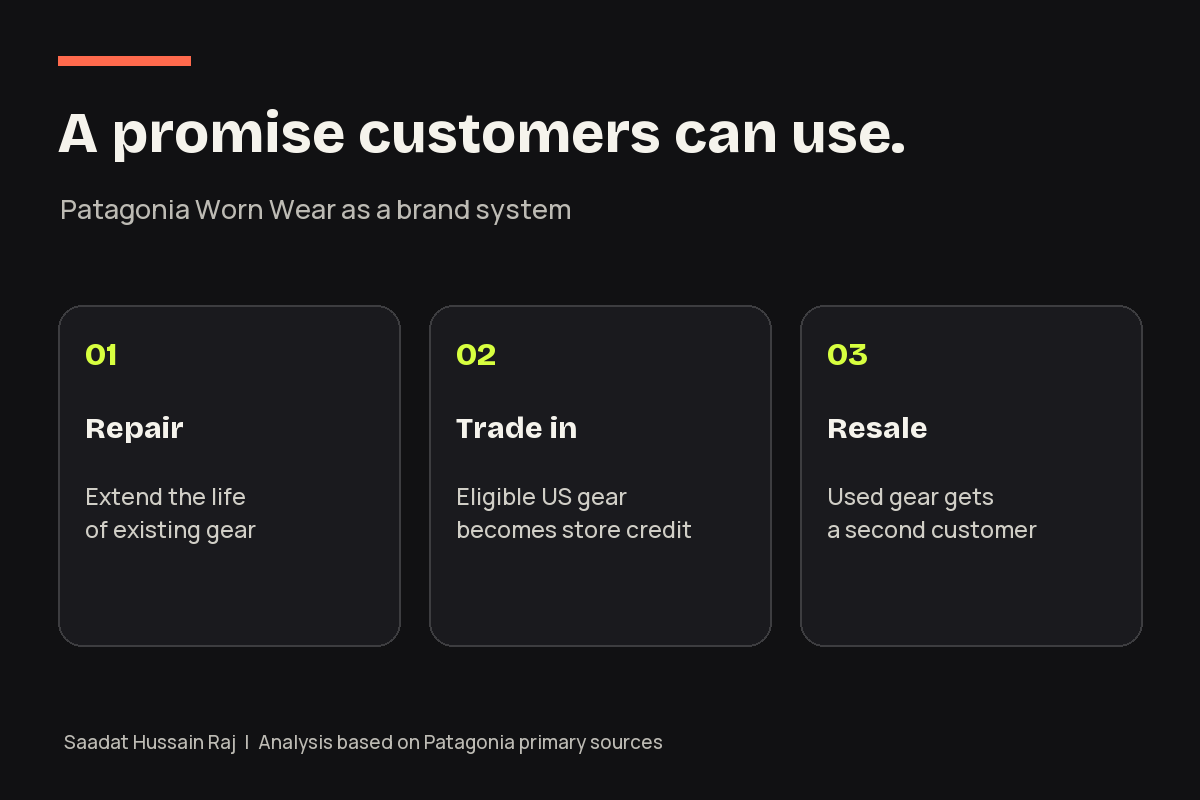
A brand promise becomes credible when a customer can do something with it.
Patagonia talks about keeping gear in use for longer. Worn Wear is the service design behind that sentence: care and repair guidance, trade-in for eligible used gear, and a place to buy used Patagonia products. The story is not simply that the brand says “reuse.” The customer can act on that idea at several moments after the first purchase.
This analysis uses Patagonia’s current US trade-in terms, Worn Wear FAQ, repair guidance and 2025 Work in Progress Report. Program details vary by location. The US trade-in page says trade-in is available in the United States; it should not be described as a universal global offer.
The promise has a customer journey
Most sustainability language sits at the point of sale. It describes a material, target or intention while asking the customer to buy a new item. Worn Wear extends the relationship into ownership. A customer can care for an item, look for repair guidance when something breaks, trade in eligible functioning gear, or buy used gear from someone else’s first ownership cycle. Each step gives the stated commitment a visible operating form.
That matters for brand trust because it creates a test. If a jacket tears, is repair help findable? If a customer no longer uses a pack, are the trade-in terms understandable? If a shopper wants a used item, can they find one with condition and guarantee information? A promise that survives these questions is more useful than a broad claim on a campaign page.
Repair is the first proof point
Patagonia’s Worn Wear repair page points customers to repair professionals and more than 100 care and repair guides made with iFixit. The brand can encourage maintenance before a new purchase because it provides an actual route to act. The precise environmental result of a repair depends on what it displaces and how long the item stays in use; the public page alone does not prove a measured reduction in total impact. The observable fact is that repair has a customer-facing path.
Trade-in makes the second life practical, with limits
The current US terms accept clean, functioning eligible Patagonia clothing and gear by mail or in a Patagonia-owned store. The customer receives merchandise credit for accepted items. The same page says a $7 fee is deducted for mailed trade-ins, lists product exclusions, and offers a return or recycling choice for ineligible gear. These details are not footnotes to the brand story. They determine whether the promise works for a real person.
Credit also creates an honest tension. It may make participation easier, but it brings the customer back to Patagonia’s commerce system and can fund another purchase. A brand analysis should see both sides. Worn Wear can extend the life of an item and strengthen a customer relationship; the trade-in mechanism is not proof that every participating customer buys less overall.
Resale gives the promise a storefront
The Worn Wear FAQ describes a used-gear shop, says items sold there are functional and backed by the Ironclad Guarantee, and traces the program from 2012 clothing swaps through repair events and an online resale shop. That gives the second life its own retail experience rather than treating used goods as an afterthought. The guarantee matters because it reduces the perceived risk of buying pre-owned gear directly from the brand.
The brand mechanism: build proof into operations
There are three linked jobs here. Repair helps an existing owner keep an item. Trade-in gives an owner an exit path for eligible gear. Resale gives the next customer an entry path. The promise is carried by policies, service pages, logistics and inventory, not just a line of copy. Patagonia’s 2025 report also frames progress alongside unresolved problems, which is more credible than pretending one program closes every environmental loop.
The transferable lesson is operational: choose a promise that can be inspected after purchase. Write the customer actions, the conditions and the handoffs. If the experience cannot support the claim at the point where a customer needs it, marketing should narrow the claim or the company should improve the experience. This is the same distinction between recognition and delivery that runs through The Logo Is the Last Thing to Change.
What we can and cannot conclude
We can observe that Worn Wear offers repair guidance, eligible US trade-in and resale with stated conditions. We cannot infer from these pages the program’s net climate effect, whether the average customer buys fewer new products, or how much of Patagonia’s sales comes from resale. Those would require separate, comparable data. The strong brand lesson here is narrower and more durable: a promise becomes more credible when customers can use it, and its limits are stated where the decision happens.
Frequently asked questions
Is Patagonia Worn Wear only resale?
No. Patagonia describes Worn Wear as trade-in and used-gear shopping, with care and repair guidance as part of the system.
Can anyone trade in any Patagonia item?
No. The current US program accepts specified clean and functional gear, excludes several categories and applies an online trade-in fee. Check the live eligibility rules before sending an item.
Does Worn Wear prove Patagonia has no environmental impact?
No. The program is an observable service that can extend product use, but its total environmental effect cannot be established from its customer pages alone.