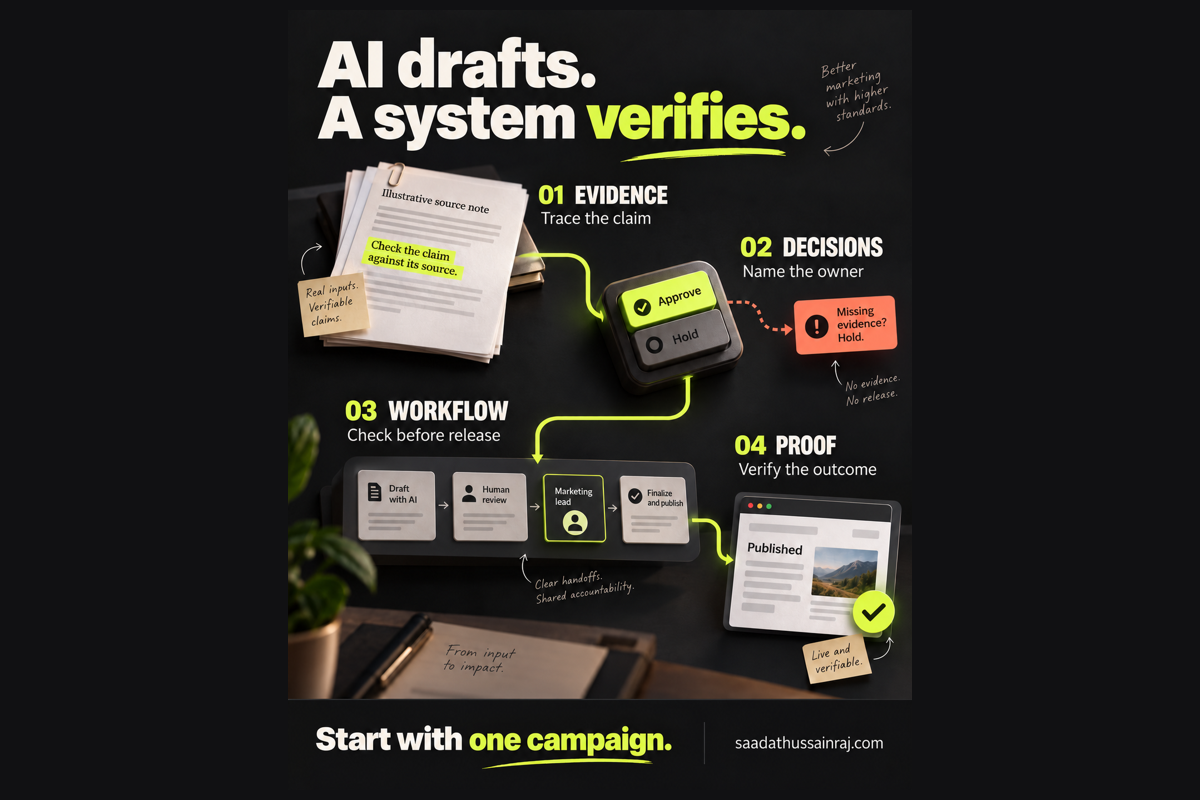
AI can produce a campaign draft quickly. The harder marketing decision is whether the draft deserves to become a public promise. I’m building my workflow around four checks: evidence, decisions, workflow and proof. The aim is to make mistakes visible and decisions explainable, not to pretend the system is already perfect.
1. Evidence: what supports the claim?
A source note should identify the exact claim, the direct source and what that source supports. A confident paragraph is not evidence. If I cannot support a number, customer result or comparison, I need to narrow it, remove it or hold the draft. This matters most when the claim makes the campaign persuasive. The central promise deserves more scrutiny than a minor descriptive detail.
Google’s guidance asks publishers to check AI-assisted content for accuracy, quality and relevance, including metadata and image descriptions. Read the primary guidance. That is a useful publishing boundary, but my operating question is more practical: where does the evidence live, and can the next reviewer find it without asking me?
2. Decisions: who owns the audience and the promise?
A model can produce alternatives. It cannot take responsibility for the business choice. Before drafting, I want one sentence naming the audience, the problem and the action the campaign should make easier. I also want an owner for the final promise. Otherwise, a polished draft can hide an unresolved positioning decision.
For an illustrative marketing service, “help businesses grow” is too broad to review. “Help a small content team identify where review work gets stuck” gives the draft a clearer job. It does not prove demand, but it makes the proposed audience and use case explicit enough to test.
3. Workflow: what must pass before release?
My preferred starting point is one campaign, one source note, one owner and one review step. The review checks the substance before the polish: supported claims, useful takeaway, correct audience, appropriate permissions and destination. Formatting matters because it helps people use the work, but it cannot repair an unsupported promise.
I also need an interruption path. If a session stops halfway through publishing, the next session should find the last verified step, the exact destination ID and the remaining action. A status that says “scheduled” should not quietly become “done.” A recovery should inspect the live destination before retrying, because a lost confirmation can hide a successful release.
4. Proof: did the intended thing actually happen?
There are two kinds of proof I need to keep separate. Delivery proof shows that the right page or post went live with the intended media and links. Outcome proof shows whether the work helped the intended audience. A scheduler response provides neither by itself. A public URL establishes delivery only after I inspect it; engagement still needs a dated measurement window and a relevant signal.
For a practical resource, a useful reader question can tell me more than an unexplained spike in visits. For a campaign with a commercial objective, qualified enquiries matter more than decorative reach. Small samples should remain small samples. I do not want a dashboard to turn uncertainty into an invented success story.
A small worked example
Imagine an AI-assisted campaign draft claims that a workflow cuts review time in half. There is no measured comparison. The evidence check removes that number. The decision check narrows the audience to a small content team. The workflow check adds a named reviewer and a release record. The proof check verifies the public page and later records whether anyone used the resource. This is an illustrative process, not a client result or a claim about my own performance.
What I’m improving next
The useful improvement is often a clearer handoff rather than another tool. If a claim is hard to trace, improve the source note. If the audience is vague, settle the decision. If a release is missed, fix ownership and recovery. If delivery works but nobody responds, test the distribution promise. These failures should not all be answered by producing more content.
I’ve turned the first check into a marketing claim worksheet. Use it on one public claim and see what changes. For context on the learning projects behind this approach, read what running two content engines taught me about systems. The framework is a method I am still improving, not a finished product or a promise of business results.