Before publishing a marketing promise, write down what you are asking the reader to believe. This copyable worksheet separates the claim, evidence, limitation and decision. It is designed for brand, campaign and content work, not as a legal approval or a statistical validation tool.
Start with the sentence that carries the sale
Do not audit every adjective with equal effort. Begin with the statement that makes a reader more likely to buy, sign up or trust you. This may be a performance number, a comparison, a customer result or a statement about who the offer is suitable for. If that sentence fails, polishing the supporting paragraphs is wasted effort.
The claim record
Copy this worksheet into a document. Keep one row per decision. The blank table below is a copyable template. The worked example in this article is illustrative, not a customer result.
| Field | Your record |
|---|---|
| Exact public sentence | Write your answer here |
| Who should believe it and why it matters | Write your answer here |
| Evidence type: measured result, primary source or interpretation | Write your answer here |
| Direct source and date | Write your answer here |
| What the evidence supports | Write your answer here |
| What it does not establish | Write your answer here |
| Permission or confidentiality boundary | Write your answer here |
| Decision: keep, narrow, remove or hold | Write your answer here |
| Final wording and next review date | Write your answer here |
Worked example
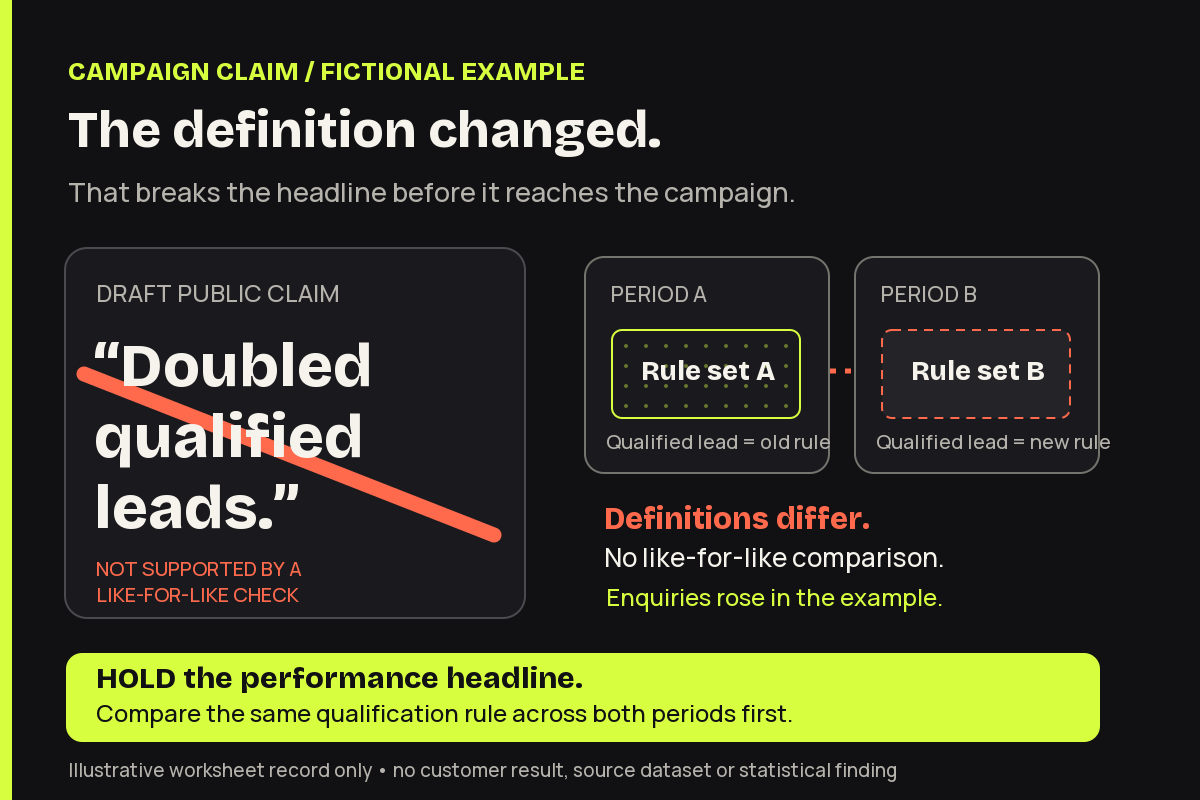
This is a fictional campaign review, not a customer result. An enquiry spreadsheet rises, but the definition of a qualified lead changes between periods. The record shows why the headline must wait.
| Field | Illustrative record |
|---|---|
| Exact public sentence | “Our campaign doubled qualified leads.” |
| Who should believe it and why it matters | A prospective client considering a lead-generation service; the result could influence a purchase. |
| Evidence type | Hypothetical enquiry spreadsheet, not verified campaign evidence. |
| Direct source and date | No real source or date: this is a fictional example. |
| What the evidence supports | Enquiries rose in the fictional record. |
| What it does not establish | Qualified leads doubled on a like-for-like definition; the qualification rules changed. |
| Permission or confidentiality boundary | No customer is identified. A real customer result would need source and permission checks. |
| Decision | Hold the doubling claim. Do not replace it with “dramatic growth,” which implies the same unsupported result. |
| Final wording and next review date | No performance headline for release. Recheck after the definitions and comparable periods are verified. |
Four decisions that keep the work moving
| Decision | Reason | Example |
|---|---|---|
| Keep | Evidence supports the exact statement | A documented feature stated within its scope |
| Narrow | Evidence supports a smaller claim | A test result limited to its actual sample |
| Remove | The claim is unnecessary or unsupported | An invented percentage in a draft |
| Hold | The central promise needs evidence or permission | An unpublished customer result |
A limitation is not a footnote designed to undo a headline. If a result applies to one case, say that in the claim. If a comparison uses published specifications rather than testing, say so where the reader makes the decision. The narrower statement may be less dramatic but more useful.
Separate observation from interpretation
Observation describes what the record shows. Interpretation explains why you think it happened. Recommendation says what to try next. Keep these sentences distinct. A rise in traffic is an observation. “The new headline caused it” is an interpretation that needs stronger evidence. “Test this headline on the next comparable campaign” is a recommendation, not a proven result.
A campaign review in ten minutes
Pick one central claim. Open its source. Identify the strongest supported wording. Check whether permission or confidential information is involved. Record one decision and the final sentence. Then ask a reviewer to find the evidence without your explanation. If they cannot, the handoff still needs work.
This does not make every claim safe or correct. Regulated, contractual or consequential promises may need a specialist review. The worksheet makes uncertainty visible; it does not remove uncertainty by giving the draft a score.
Why I use this with AI-assisted work
AI makes plausible phrasing easy to produce. That increases the value of an explicit source and decision record. Google recommends reviewing AI-generated material for factual trustworthiness, including metadata. Read the publishing guidance. My worksheet is an original marketing review method built around that practical need, not an endorsement by Google.
Next, read the four checks in my marketing workflow. Use one claim today, and keep the record beside the next draft rather than leaving it in a separate archive.