
Two small side projects taught me more about building systems than any framework I have read.
I have spent the last few months building two small brands on the side, one on marketing systems, one on home-office gear reviews, as a way to learn by doing rather than by reading about it. Neither is a company. Neither has a team. They are closer to a lab: a place to test whether an idea about how marketing should work actually survives contact with a real audience, a real website, and real publishing deadlines.
What I did not expect going in was how much the two projects would teach me about systems thinking specifically. Not marketing tactics, but the underlying discipline of building something that keeps running without you personally pushing every button.
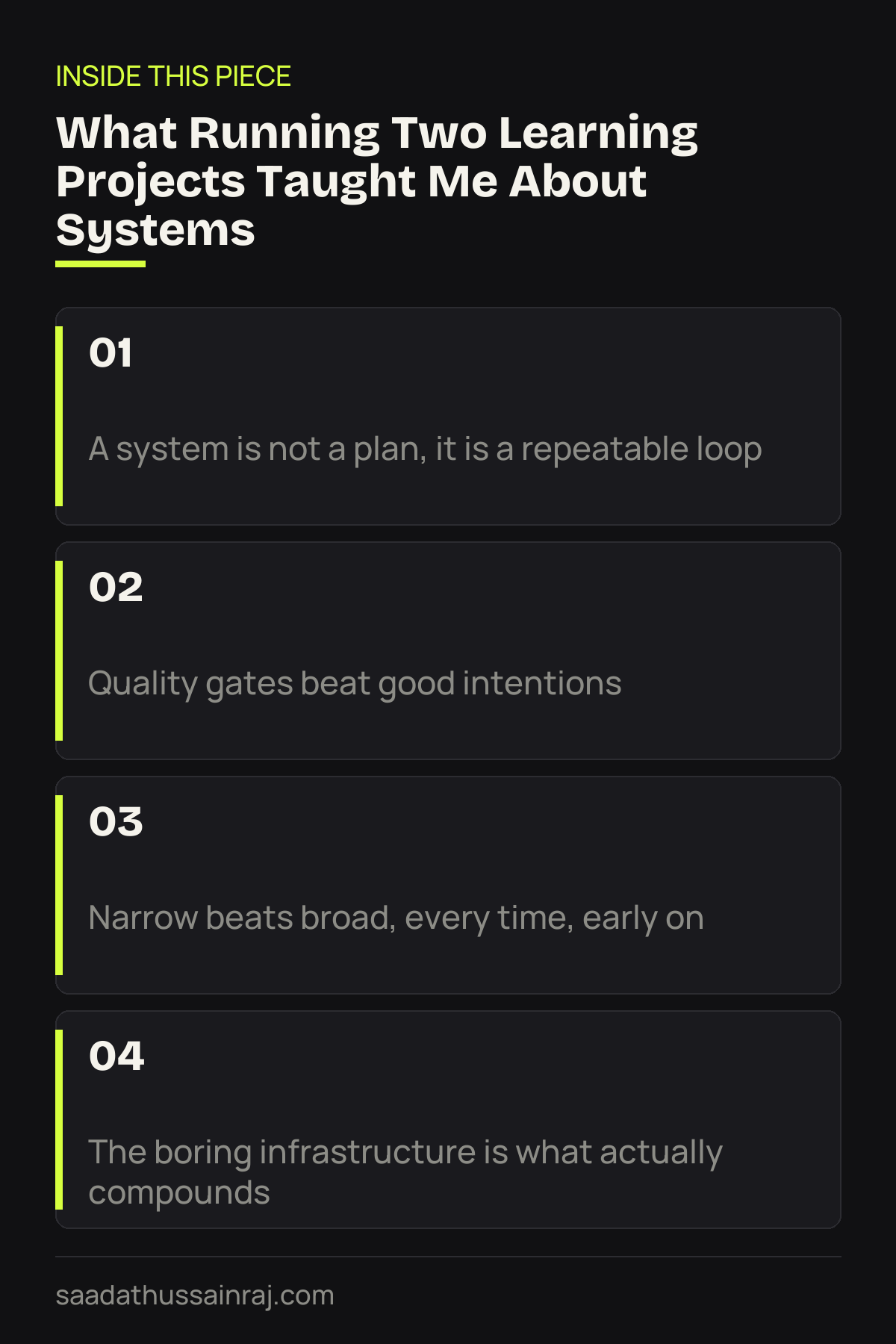
A system is not a plan, it is a repeatable loop
Early on, I treated both projects like a series of one-off tasks. Write a post. Post it. Think about what to do next. That works for exactly as long as you have the energy to sit down and decide from scratch every single time, which is to say, not very long.
The shift that actually mattered was moving from “what should I do today” to “what does the loop look like, and what feeds into it.” A loop has inputs (what topic, what format, what has already been covered), a repeatable process (research, draft, check against a standard, publish), and an output that feeds the next loop (what worked, what did not, what to avoid repeating). Once that loop exists, the question stops being “what do I do” and becomes “did the loop run correctly this week.” That is a completely different, much lighter cognitive load.
Quality gates beat good intentions
Both projects run on a checklist before anything goes live: tone, sourcing, formatting, whether a claim is actually backed by something real. Early versions of both projects did not have this, and the difference was obvious within weeks. Without a gate, quality drifts toward whatever is fastest to produce. With a gate, quality has a floor, even on a day when the fast version would have been tempting.
The lesson generalizes past content: any system that depends on someone remembering to be careful will eventually fail, not because people are careless, but because memory is an unreliable control mechanism. A checklist that has to be satisfied before something ships is a much better control mechanism than a good intention.
Narrow beats broad, every time, early on
Both projects started with the temptation to cover everything relevant to the topic. Both got meaningfully better the moment they picked one narrow slice and refused to leave it until that slice was actually done well. This is not a novel insight, focus is standard advice, but living it out made the reason for it concrete in a way reading about it never did: a narrow, deep body of work reads as expertise. A broad, shallow one reads as a hobby. Search engines and readers both reward the former and are indifferent to the latter, and there is no shortcut around putting in the depth first.
The boring infrastructure is what actually compounds
The exciting part of building something is the creative decisions: what to write about, what it should look like, what the voice should be. The part that actually determines whether the thing survives six months later is the boring infrastructure underneath it. A place to track what has already been covered so you do not repeat yourself. A checklist that runs the same way every time. A habit of writing down what worked so the next decision is informed instead of guessed.
None of that is glamorous. All of it is the difference between a project that is still running in month six and one that quietly stopped in month two because every decision had to be re-derived from scratch, which is exhausting in a way that is not obvious until you have tried to skip it.
Why this matters beyond the two projects
I did not start either project to build a business. I started them to have a real, low-stakes place to test ideas about how marketing and systems thinking actually work, ideas that are much harder to test honestly inside a single full-time role, where the cost of a failed experiment is higher and the feedback loop is slower. Small, self-directed projects are a genuinely underrated way to build that kind of practical judgment. You learn faster when the mistakes are cheap and the loop from idea to result to lesson is measured in days, not quarters.
The specific lessons above, loops over one-off tasks, gates over good intentions, narrow over broad, infrastructure over inspiration, are not really about marketing at all. They are about how to build anything that has to keep working when you are not standing over it. That is the actual return on two side projects that, on paper, are just a blog about AI marketing and a blog about desk gear.