Every competitive analysis I have seen names the wrong enemy.
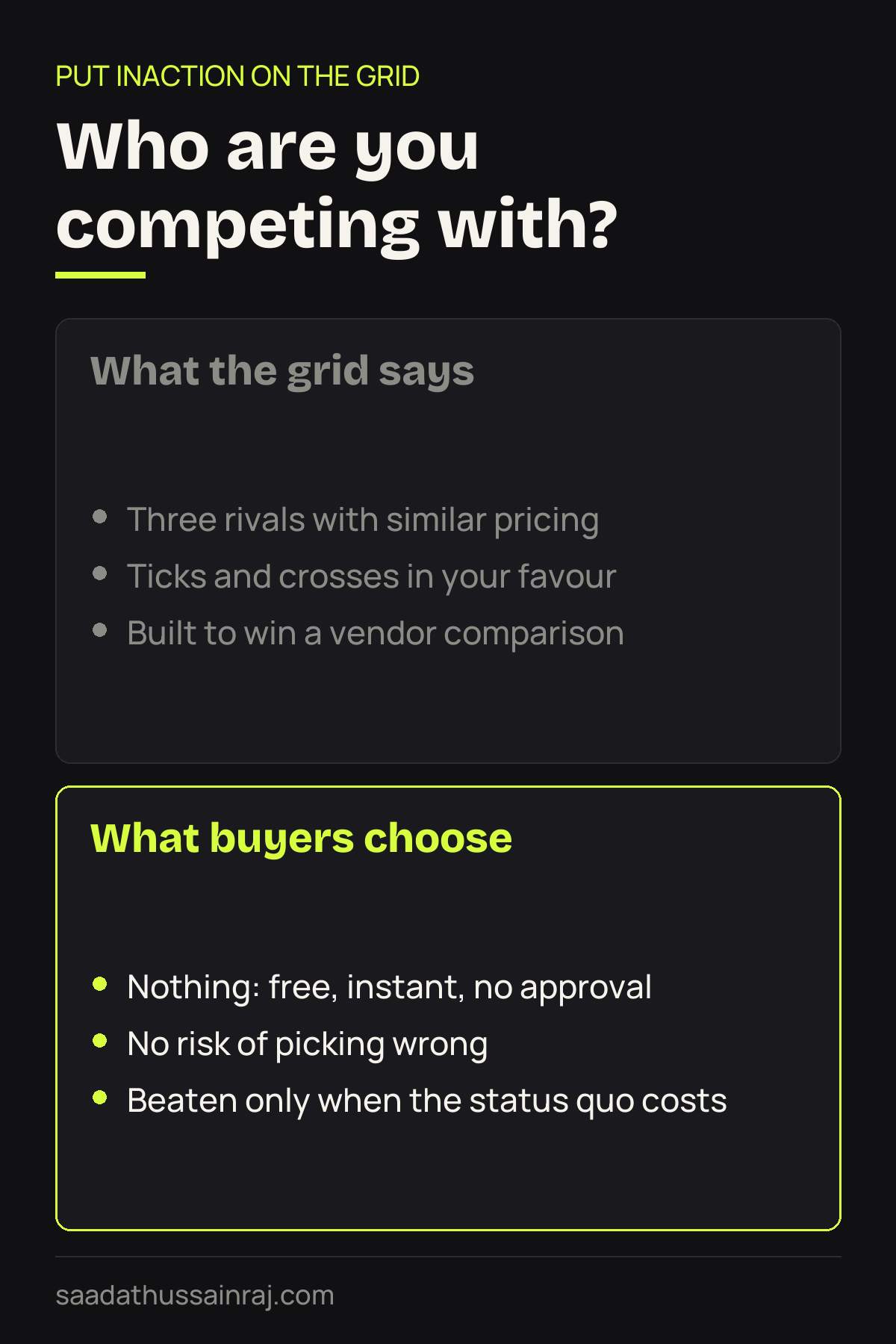
Ask a marketing team who they compete with and you get a list of companies. Three or four names, usually the ones with a similar logo and a similar price. Somebody has built a grid. The grid has ticks and crosses in it, and the ticks are mostly on our side, which is how you know who made the grid.
Then you go and talk to the people who did not buy, and almost none of them were choosing between you and the names on that grid. They were choosing between doing something and doing nothing. And nothing won.
Nothing is the market leader
In most categories, the largest share belongs to inaction. The spreadsheet nobody replaced. The agency nobody fired. The process everyone complains about in meetings and then keeps, because changing it means somebody has to own the change and that person has a full calendar already.
Nothing has advantages no competitor can match. It costs no money. It requires no approval. It carries no risk of being the person who picked the thing that did not work. It is available immediately and it never has an onboarding call. If you built a competitor with that feature list you would be terrified of it.
And yet it appears on almost no competitive grid, because it does not have a logo to put in the header row.
What this does to your messaging
Once you accept who you are actually up against, most brand messaging starts to look like it was written for the wrong fight.
Comparison messaging assumes the buyer has already decided to buy something and is now picking a vendor. Faster than. Cheaper than. More integrations than. All of that only lands on a person who is already in market. If your real competitor is inaction, then every one of those lines is answering a question your buyer has not asked yet.
The question they are actually sitting with is smaller and more uncomfortable: is this worth the disruption? Not is this better, but is this better by enough to justify the meetings, the migration, the risk of looking foolish. That is a completely different argument, and it is won with a different kind of evidence. Not feature comparisons. Cost of the status quo, made specific and made personal.
The two questions that beat a grid
I have started replacing competitive analysis with two questions, and they surface more than a grid ever has.
First: what happens if they do nothing for another year? Not in general terms, in their terms. What does the spreadsheet cost them in the twelfth month. What does the slow process do to the deal they are trying to close in March. If you cannot answer that with something concrete, you do not have a positioning problem, you have a value problem, and no amount of messaging will paper over it.
Second: who inside the company has to stick their neck out for this to happen? Every purchase has a person whose reputation moves with it. Most marketing is written for the company and almost none of it is written for that person. Give them the argument they need to make internally, in a form they can forward without editing, and you have done more for the deal than another comparison page ever will.
Where I keep seeing this
I run two learning projects on my own time, and both taught me the same lesson from opposite directions. One is about marketing systems, one is about the gear people put on their desks. Completely different audiences, identical failure mode: it is easy to write about why your approach beats the alternative approach, and much harder to write about why the reader should do anything at all this month rather than next year.
The pieces that get read are almost never the comparisons. They are the ones that name a cost the reader was already quietly paying and had stopped noticing. That is not a content insight. That is the whole positioning problem showing up in miniature.
The uncomfortable version
If nothing is beating you, that is not a marketing failure by default. Sometimes it is honest feedback. Sometimes the disruption genuinely is not worth it for that buyer this year, and the right answer is to go and find the buyers for whom the status quo has become expensive enough to hurt.
But you cannot tell those two situations apart while your competitive set is a list of companies. You have to put inaction on the grid first, give it a column, and be honest about how well it is doing. In most categories it is winning comfortably, and it is not even trying.
If you are working on positioning and want a second opinion on who you are actually competing with, I would be glad to hear about it. Get in touch, or see the Work page for more of the thinking behind this.