Every “how did they tweet that so fast” moment gets studied as a speed problem, and almost never is one.
Every year there’s a new moment like this, and every year a dozen brands try to copy the speed and skip the part that actually made it work.
Take the most famous example: during a stadium blackout at the 2013 Super Bowl, Oreo’s team put out a single image within minutes. Dark background, one cookie lit up, and a line that read “you can still dunk in the dark.” People still bring it up more than a decade later, and the usual lesson people take from it is “be fast.” That’s the wrong lesson.
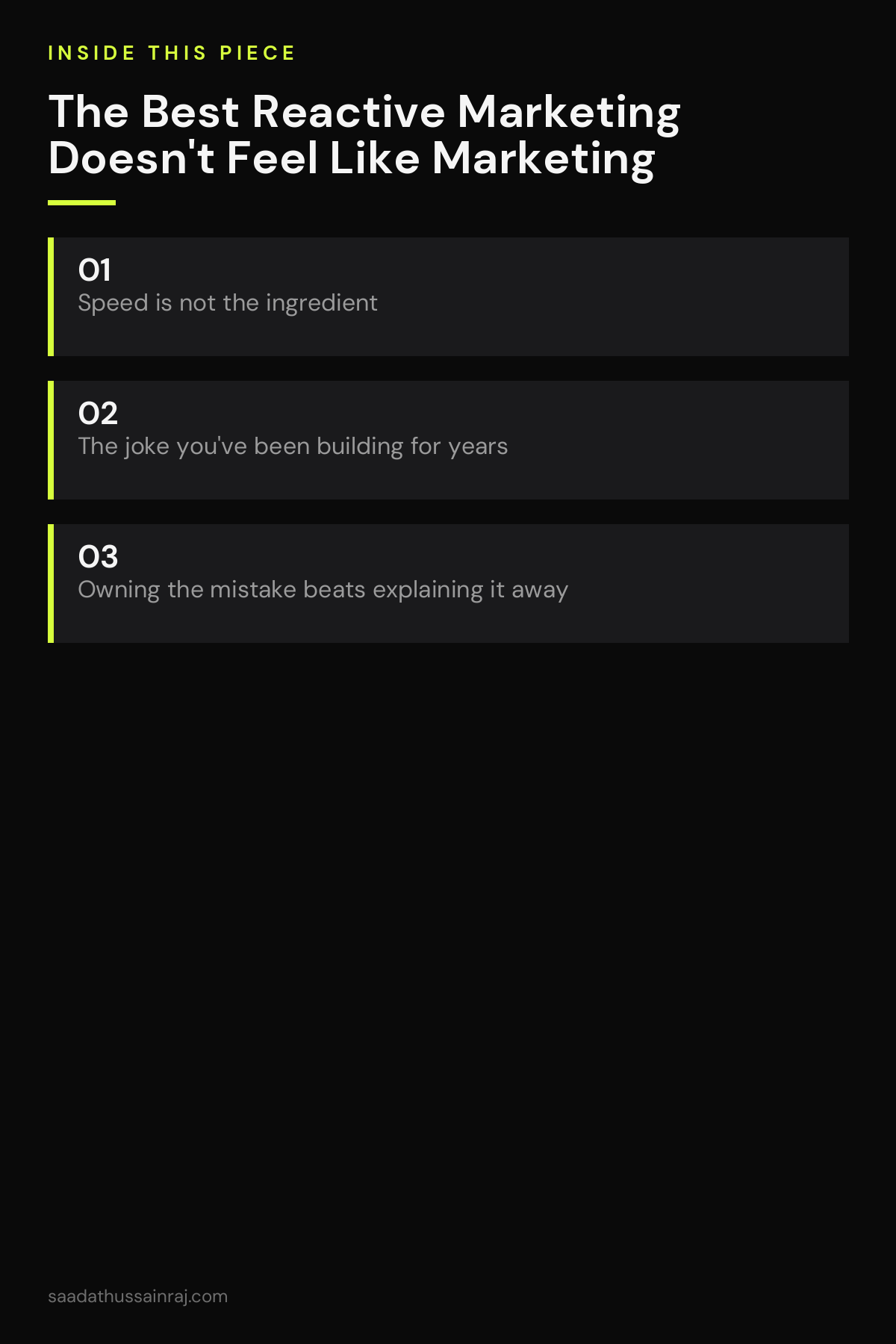
Speed is not the ingredient
The tweet worked because Oreo already sounded like that. Playful, a little smug, comfortable being silly about a cookie. If a bank or an airline had tried the exact same joke in the exact same minute, it would have read as strange, because nobody had ever heard a bank sound like that before. The blackout didn’t create the voice. It just gave an already-established voice something to react to.
This is the part that gets skipped when people study reactive marketing as a speed problem. Speed only pays off when there’s already a personality on file for people to recognize. Without it, a fast reaction just looks like panic with good grammar.
The joke you’ve been building for years
Wendy’s Twitter account spent years trading light insults with people who tagged the brand, long before anyone called it a “strategy.” Most of those exchanges were small and forgettable. That’s exactly the point. By the time Wendy’s roasted a competitor or a customer in a way that actually went viral, the audience had already decided the account was allowed to talk that way. The viral moment was the payout on years of low-stakes deposits, not a standalone stunt.
Brands that try to skip straight to the payout, cracking one big joke with no track record of that voice, usually get read as trying too hard. The internet is unusually good at telling the difference between a brand that has earned its tone and one that borrowed it for a day.
Owning the mistake beats explaining it away
In 2018, a chicken restaurant chain in the UK ran into a supply problem and had to close most of its locations for several days. Rather than a careful statement full of hedging, the response rearranged the letters of the brand’s name on an empty bucket into something close to a swear word, with a plain, funny apology underneath. No blaming the supplier out loud, no corporate distance from the mess. Just: we messed up, here’s an empty bucket, sorry.
It worked because it never punched down at the customers who were actually inconvenienced. The joke was aimed entirely at the company itself. That’s the line most reactive “crisis” content misses: humor about your own failure can land, humor at the expense of the people affected by it never does.
When reactive marketing feels calculated instead of quick
Not every fast reaction earns goodwill. When two rival supermarkets in the UK got into a public back-and-forth over a caterpillar-shaped cake that looked suspiciously similar to a competitor’s, the exchange only worked as long as it read like genuine, mutual sparring between two brands that both found it funny. The moment either side had pushed it further than the joke could carry, or aimed it at customers instead of each other, it would have curdled into something that looked like manufactured drama rather than wit.
The difference between “clever” and “trying too hard” usually comes down to restraint. The best reactive moments know exactly when to stop.
The part a machine can’t fake
More of marketing is going to be produced faster, with tools that can draft a response in seconds instead of hours. Fine. A machine can help you react quickly. It still can’t invent a personality nobody’s met yet, and that’s the part that was always doing the work.
The brands still landing the joke five years from now will be the ones that did the slow, unglamorous part first. Decide what you actually sound like. Say it enough times that people notice. Then, and only then, trust yourself to improvise in public.
Reactive marketing isn’t a tactic you deploy when something happens. It’s a dividend, paid out by a voice you already built.
If you’re thinking through how your brand should sound when something happens in real time, I’d like to hear about it. Get in touch, or see the Work page for more of the thinking behind this.