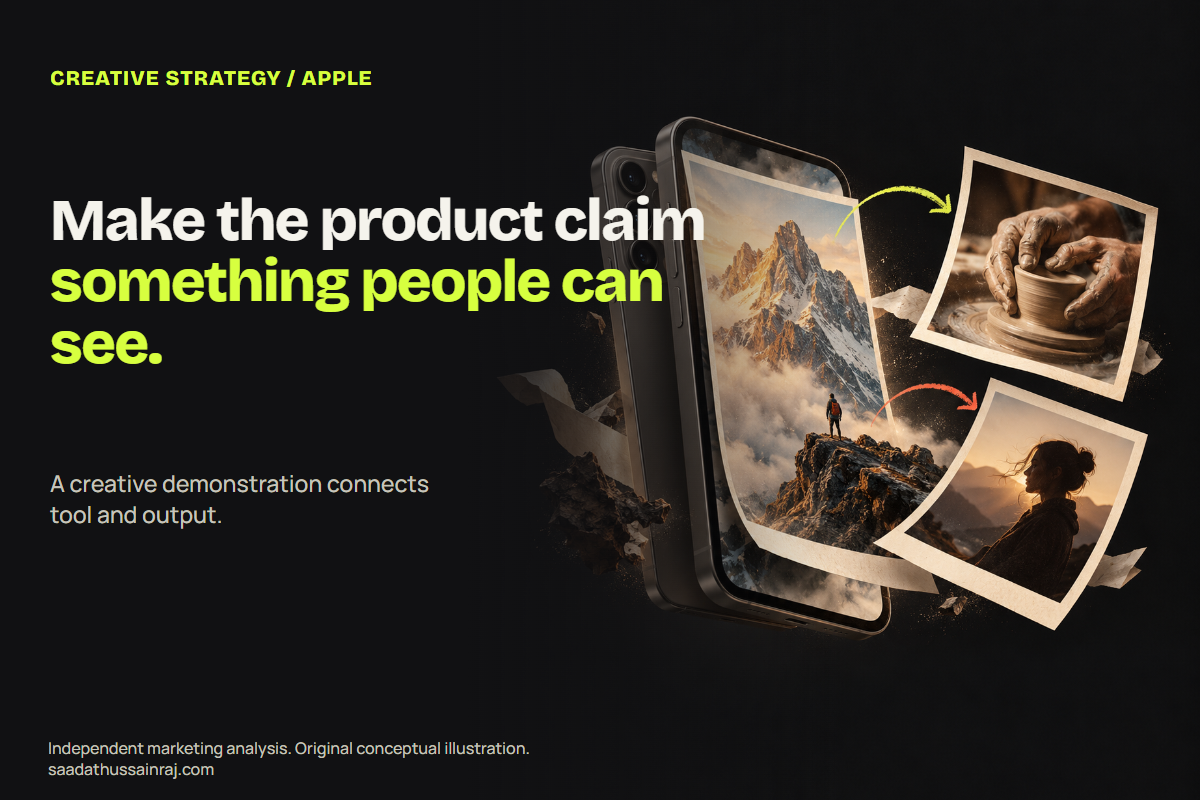
A product claim becomes easier to inspect when the audience can see something made with the product. Apple’s photography exhibition “What Holds Us” offers a useful example. Rather than treating a creative output only as decoration around the device, the work itself becomes part of the demonstration.
Apple’s 16 September 2026 announcement presents photographs made on iPhone 18 Pro by Alex Prager, Jack Davison and Jimmy Chin, curated by Kathy Ryan. The exhibition explores human connection through three distinct artistic perspectives. Those are the published project facts. My interest here is the marketing structure, not a review of the phone or an independent test of its camera.
Start with a result people can inspect
A technical specification can tell a potential buyer what a product contains. A finished image offers a different kind of information: an example of what someone made with it. The two can complement each other. Neither should be mistaken for the complete buying decision.
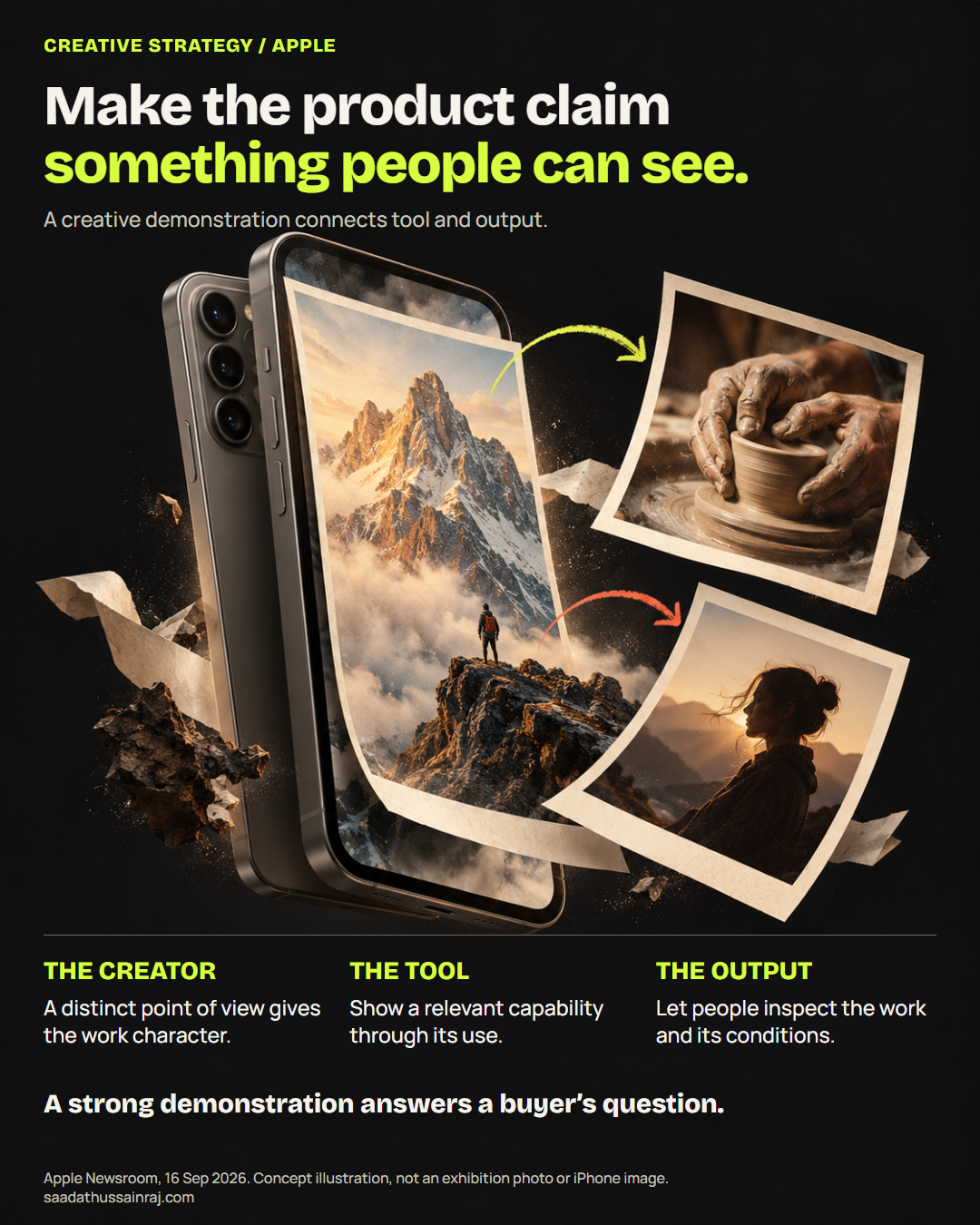
For the creative brief, the important shift is from “tell people the product is capable” to “choose a piece of work that makes a particular capability visible.” That forces useful decisions. Which capability matters? What result would make it understandable? What needs explaining about the conditions under which it was made?
A demonstration is strongest when those questions are answerable. If the output is attractive but has little connection to the product’s promised benefit, it may function as mood rather than proof. Mood has a role in advertising, but the team should know which job it has assigned to the asset.
Different creators can reveal different uses
The exhibition does not rely on a single visual treatment. Its named artists bring different approaches to the same broad theme. That makes the format interesting as a creative system: a common product and organising idea can support visibly different work.
My reading is that variation can make the proposition more concrete without forcing every creator into an identical template. The device remains part of the explanation, while the artist’s choices give each output its character. The lesson is to define what holds the work together and what the collaborators should be free to change.
This is not an argument that hiring a famous creator automatically improves a campaign. The relationship between the creator, the product and the intended result still needs to be credible. A recognisable name cannot repair a demonstration that fails to explain anything useful.
Show the conditions beside the result
Professional work reflects more than a device. The creator’s judgment, subject, preparation and production choices matter too. A marketing team should explain material conditions rather than let the audience assume that buying the product guarantees the same result.
That does not make a professional demonstration meaningless. It changes the claim it can support. “This was made using the product” is narrower than “every customer will get this result.” Keeping the distinction visible protects the useful part of the demonstration and makes room for more informative questions.
For a smaller business, the equivalent might be a designer showing a completed layout, a kitchen-tool maker demonstrating a specific preparation task or a software team showing the actual saved output. The right example depends on the buyer’s decision. It should make a relevant benefit visible under understandable conditions.
A practical demonstration brief
Write down the buyer’s question before choosing the visual. Then select one capability and one observable output. Describe the setup, the material limitations and what the viewer should be able to inspect. Choose the creator because their work helps reveal that capability, not simply because their following is large.
Keep the next action connected to the demonstration. If the viewer wants to understand how the work was made, offer the process. If they need to assess compatibility or suitability, give them the relevant details. A beautiful asset followed by an unrelated destination wastes some of the attention it earned.
For measurement, separate attention to the creative from understanding of the product benefit and from purchase behaviour. The exhibition announcement alone does not establish sales impact. The same caution applies to our own marketing: visible polish is worth pursuing, but it is not a measured commercial result.
The lesson for a brand team
Choose a result that makes a relevant product claim inspectable. Give the creative work room to be interesting, explain the conditions honestly and make the next step useful. The demonstration should answer a buyer’s question as well as catch their eye.
IKEA’s design choices offer a related lesson about making a promise tangible. LEGO Ideas illustrates why a visible audience signal still needs a careful interpretation.
Source: Apple Newsroom, “What Holds Us,” 16 September 2026, checked 1 November 2026. Independent marketing analysis, not hands-on testing. The accompanying conceptual illustration is not a photograph from the exhibition and was not shot on an iPhone.