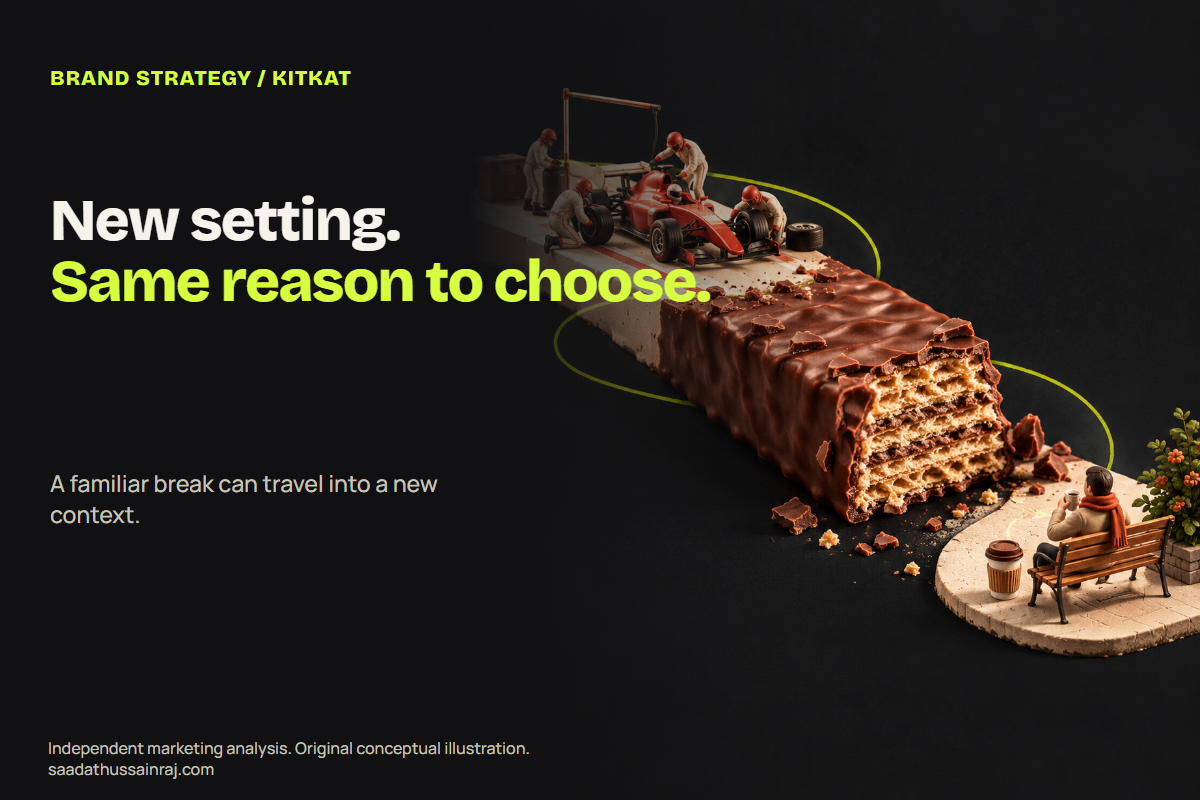
KitKat’s useful marketing lesson is not that every brand should sponsor a sport. It is that a familiar buying occasion can travel into a new setting without losing its meaning. In this case, the connection is a break. The interesting strategic question is whether a partnership gives that idea a new expression, rather than merely adding another logo.
Nestlé Malaysia’s 19 August 2026 announcement describes KitKat’s Formula 1 activation through the pit-stop metaphor. It connects race-day activity with the brand’s longstanding invitation to pause. The execution includes roadshows, racing simulators and limited-edition products. These are announced activities, not evidence here of sales lift or long-term brand growth.
The connection has to do some work
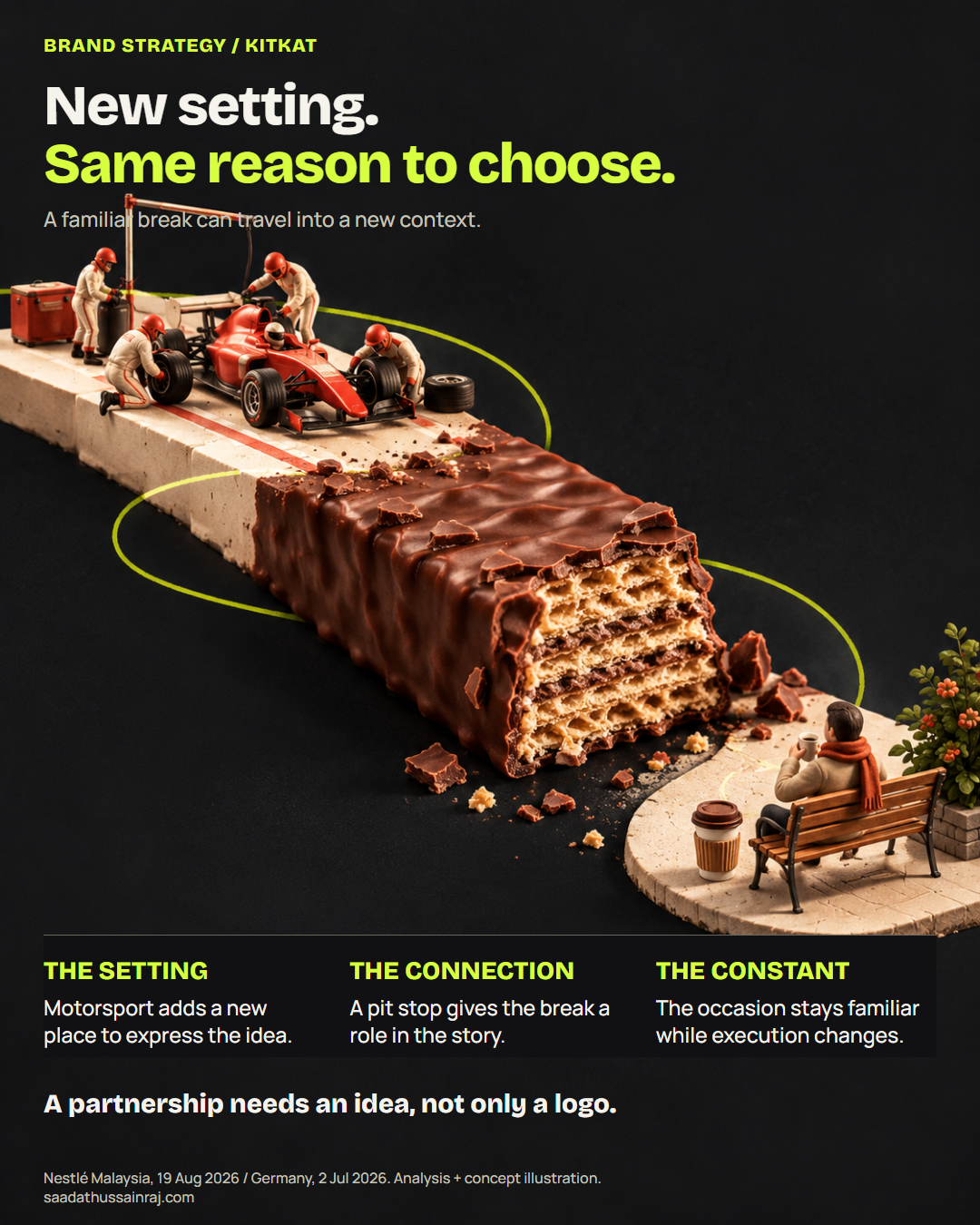
A pit stop supplies a recognisable moment within racing: activity pauses so the team can attend to the car. A personal break is a different activity, but the association gives the partnership an idea to organise around. It offers more creative direction than “our audience watches this sport.”
For a marketer, that distinction matters before buying rights or commissioning an activation. Audience overlap can help identify an opportunity. It does not tell the creative team what to make. The stronger brief identifies what the brand can contribute to the occasion and which familiar association the execution should reinforce.
That is my interpretation of the public work, not a claim to know Nestlé’s internal strategy. The visible connection is what makes the case worth examining: an established idea has a role inside the chosen setting.
One idea, different expressions
The same discipline appears in a separate July 2026 German announcement. KitKat’s Spider-Man film collaboration brought the break idea into packaging, digital media and an outdoor installation with a place to sit. The settings differ, while the pause remains the organising idea.
The point is not to make every campaign identical. A racing activation needs different objects and participation from a cinema collaboration. Consistency can live at the level of the idea, while the execution changes with the audience and environment. Repeating exactly the same visual everywhere would miss some of the opportunity of each setting.
This is where brand consistency becomes a creative constraint rather than a template. The brief says what must remain recognisable. It should still leave room for an execution that belongs in its particular setting.
The partnership test I would put in a brief
Start with the moment the brand wants to be associated with. Then describe the new setting without mentioning the proposed partner’s name. What are people doing there? Where could the product or brand play a credible role? What should the audience remember after the activation ends?
Next, ask the creative team for an expression of that connection. If the entire idea disappears when the logo is covered, there may be little beyond sponsorship visibility. That does not make visibility worthless. It means the team should describe the investment honestly and judge it against that job.
Finally, connect the attention to a real next step. The experience, packaging and retail presence should make sense together. A memorable event cannot compensate for a product that is unavailable, a promotion that is difficult to understand or a promise the customer cannot recognise later.
What this case does not establish
The public announcements show the intended association and the forms of activation. They do not by themselves establish incremental purchases, efficient acquisition or a durable change in brand memory. Those questions need defined measures and an appropriate comparison. A neat creative explanation is not a substitute for evidence of effectiveness.
For a future brief, I would separate three questions: did people notice the execution, did they connect it with the intended brand and occasion, and did it change the relevant behaviour? Those outcomes can diverge. That separation helps a team learn from a partnership without claiming that every visible success proves commercial growth.
The practical lesson
Change the setting when it gives a familiar idea a useful new expression. Preserve the reason the brand belongs there. A partnership brief should make that connection explicit before the asset list begins.
For a related example of a promise shaping the product itself, read IKEA: a brand promise built into the product. For a different mechanism, Spotify Wrapped shows how a personal story becomes something people can share.
Sources: Nestlé Malaysia, 19 August 2026 and Nestlé Germany, 2 July 2026, checked 1 November 2026. Independent marketing analysis. The accompanying image is an original conceptual illustration, not a campaign photograph or an endorsement.