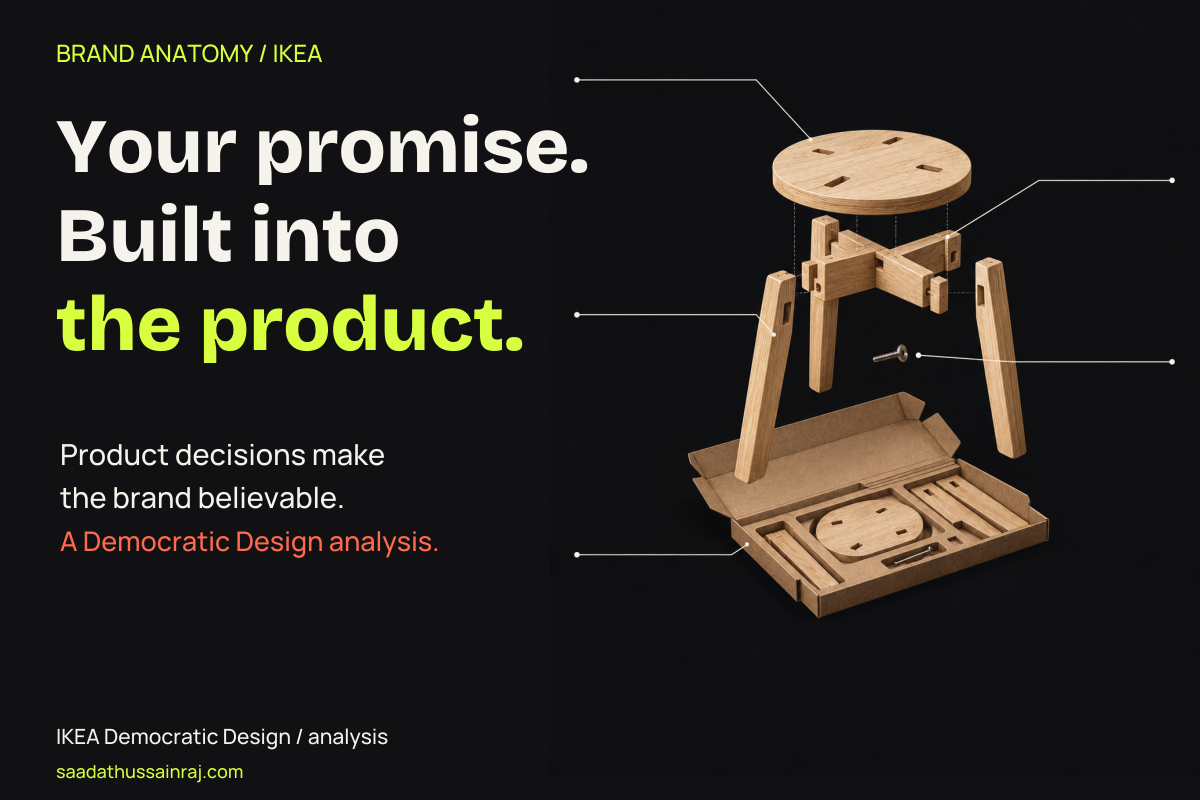
A brand promise is easier to believe when the product gives people a reason to believe it. IKEA offers a useful example: its Democratic Design principles connect the brand story to decisions about what gets made.
The lesson for marketers is practical. Before writing a stronger claim, ask what a customer could see, use or check that would make the claim credible.
Five demands on one product
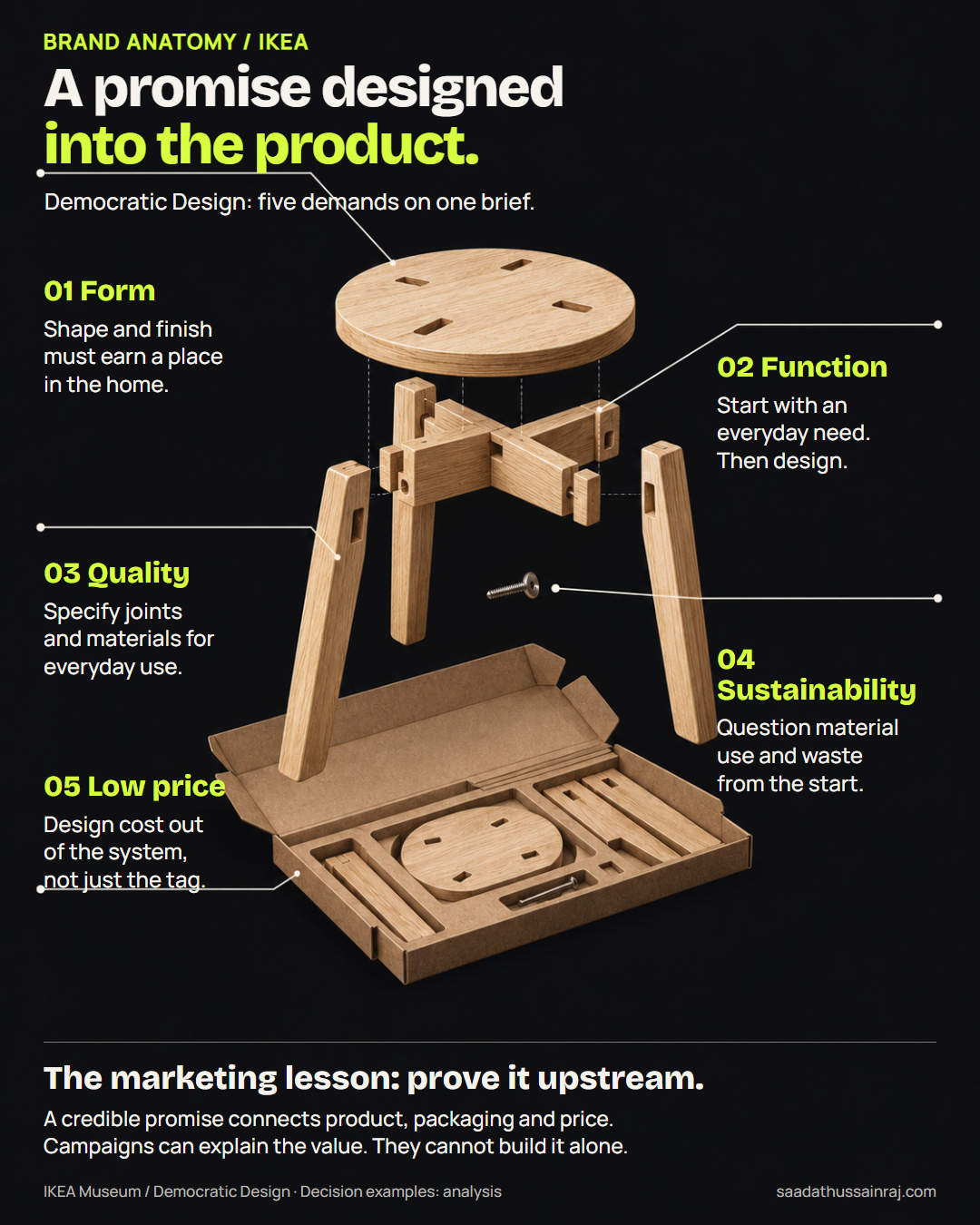
IKEA names five dimensions: form, function, quality, sustainability and low price. IKEA Museum describes Democratic Design as both a guide for product development and a way to communicate ideas.
These dimensions raise different questions. Does it look right in the home? Does it do the job? Will the chosen materials and construction suit everyday use? What resources does it use? Can the intended customer afford it?
Those questions are my interpretation of the principles, not a claim that every IKEA product meets every expectation. The exploded flat-pack illustration below is original and does not depict a named IKEA product.
What marketers can borrow
The useful move is to connect a promise to a decision. If a brand promises simplicity, look at assembly, instructions, setup and support. If it promises accessibility, examine the price and the effort needed to get started. A campaign can explain those choices; it cannot replace them.
This also makes a brief more useful across a team. A designer, a product manager and a marketer can each point to a decision they control. The conversation becomes more specific than asking everyone to make the brand feel better.
Try it with one promise
1. Write the promise in one plain sentence. Choose something a customer would understand without an explanation.
2. Name the product or service decision that supports it. An easy setup promise, for example, should lead to a concrete setup decision. This is an illustrative test, not a claim about an IKEA product.
3. Choose the proof a customer can inspect. Then check that the campaign describes that proof accurately, including its limits.
If there is no supporting decision yet, that is a useful finding for the team. It is a reason to improve the offer before making the promise louder.
The takeaway
A credible brand story gives the team something to build and the customer something to recognise. Product, packaging, price and communication should tell a connected story.
Related reading: a simple worksheet for checking marketing claims and how Patagonia Worn Wear connects a promise to an experience.
Source: IKEA Museum: Democratic Design, checked 20 October 2026. Independent brand analysis; no commercial relationship or product-performance claim is implied.