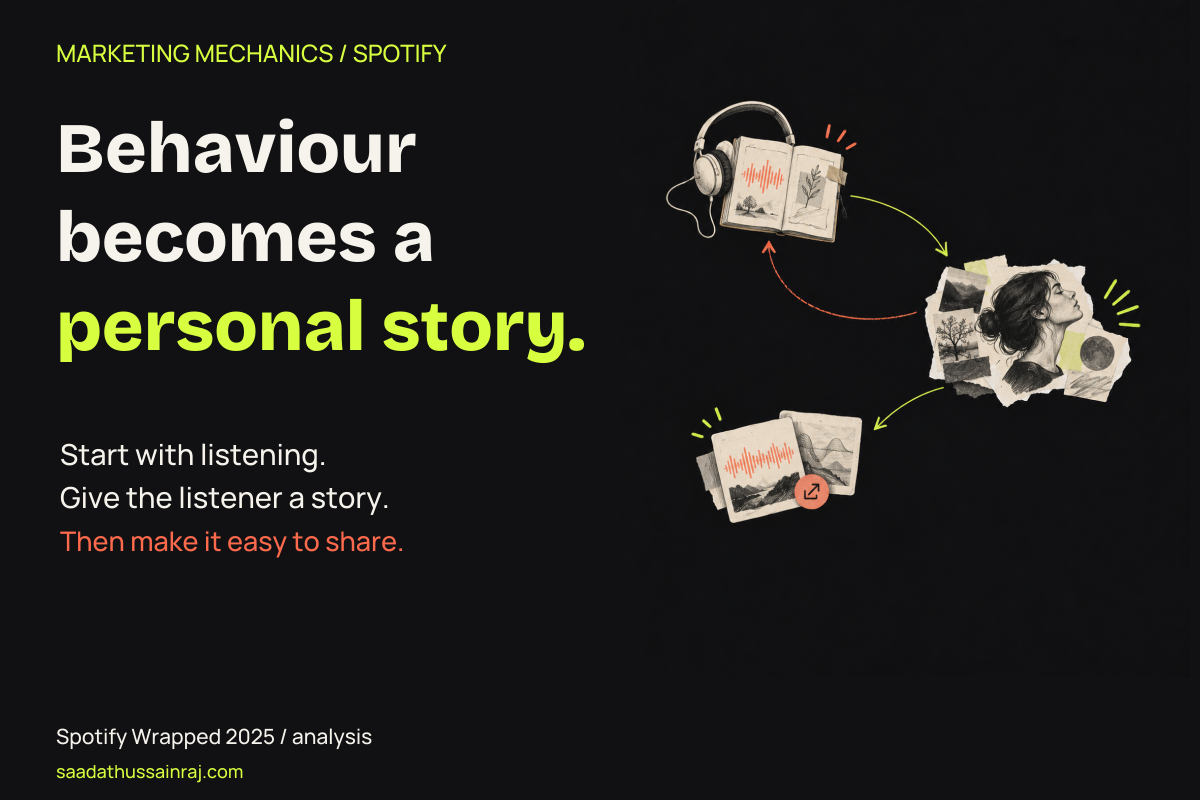
Spotify Wrapped turns listening history into something people can recognise about themselves. That makes it a useful case for marketers thinking about what people choose to share.
This analysis looks at the documented 2025 experience. It does not describe an unreleased 2026 campaign or claim a measured effect on sales or retention.
Three connected choices
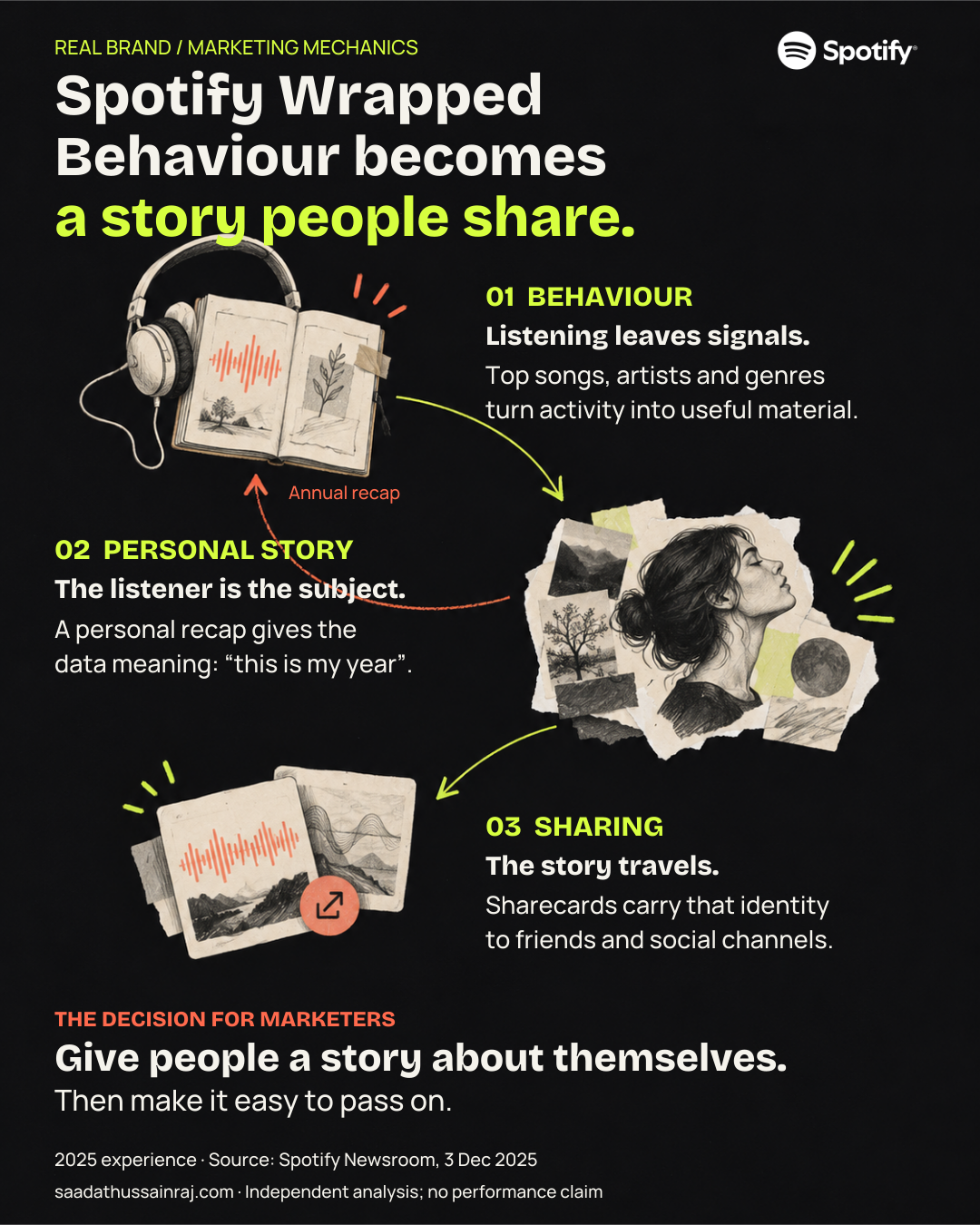
First, the experience starts with behaviour already created in the product: listening. In its 2025 announcement, Spotify describes personalised stories based on that listening history.
Second, the stories put the listener at the centre. The documented experience includes familiar elements such as top artists and songs. The information becomes a recap about the person rather than a general message about the service.
Third, Spotify provides share cards that people can send to friends or post on social channels. The sharing action is connected to the personal story the listener has just seen.
Why that sequence is useful
My interpretation is simple: the person gets a reason to care before being asked to distribute anything. A statement about their tastes may give them something to say in a conversation. The brand becomes part of that conversation because it helped create the story.
That is a design lesson, not proof that every recap will spread. The meaning of the information, the audience and the willingness to share all matter. An annual recap also gives people a new period to reflect on; it is not evidence of an automatic growth loop.
A better question for a creative brief
Instead of starting with how to make people share an advertisement, ask: what would this let a customer say about themselves?
A useful answer could be about taste, progress or a shared interest. It should come from something meaningful in the actual experience. Adding a share button to a generic message does not create that meaning.
For example, a learning service might help someone describe a skill they have practised. That is an illustrative application of the idea, not a claim about Spotify or evidence that a particular feature works.
Three checks before borrowing the idea
1. Is the information useful or recognisable to the customer, not just interesting to the marketing team?
2. Does sharing let the person express something they choose to make public? Use appropriate permissions and give them control; private activity should not become a public story by default.
3. Is the story easy to understand outside the product? A friend should not need a long explanation to understand what has been shared.
The takeaway: give people a story about themselves, then make it easy to pass on. Start with the customer value, and test whether the sharing mechanism serves it.
Related reading: how LEGO made room for an adult audience and thinking about the reaction a creative idea earns.
Source: Spotify Newsroom: the 2025 Wrapped experience, published 3 December 2025 and checked 20 October 2026. Independent analysis; the illustration is an editorial interpretation, not an official Spotify screen.