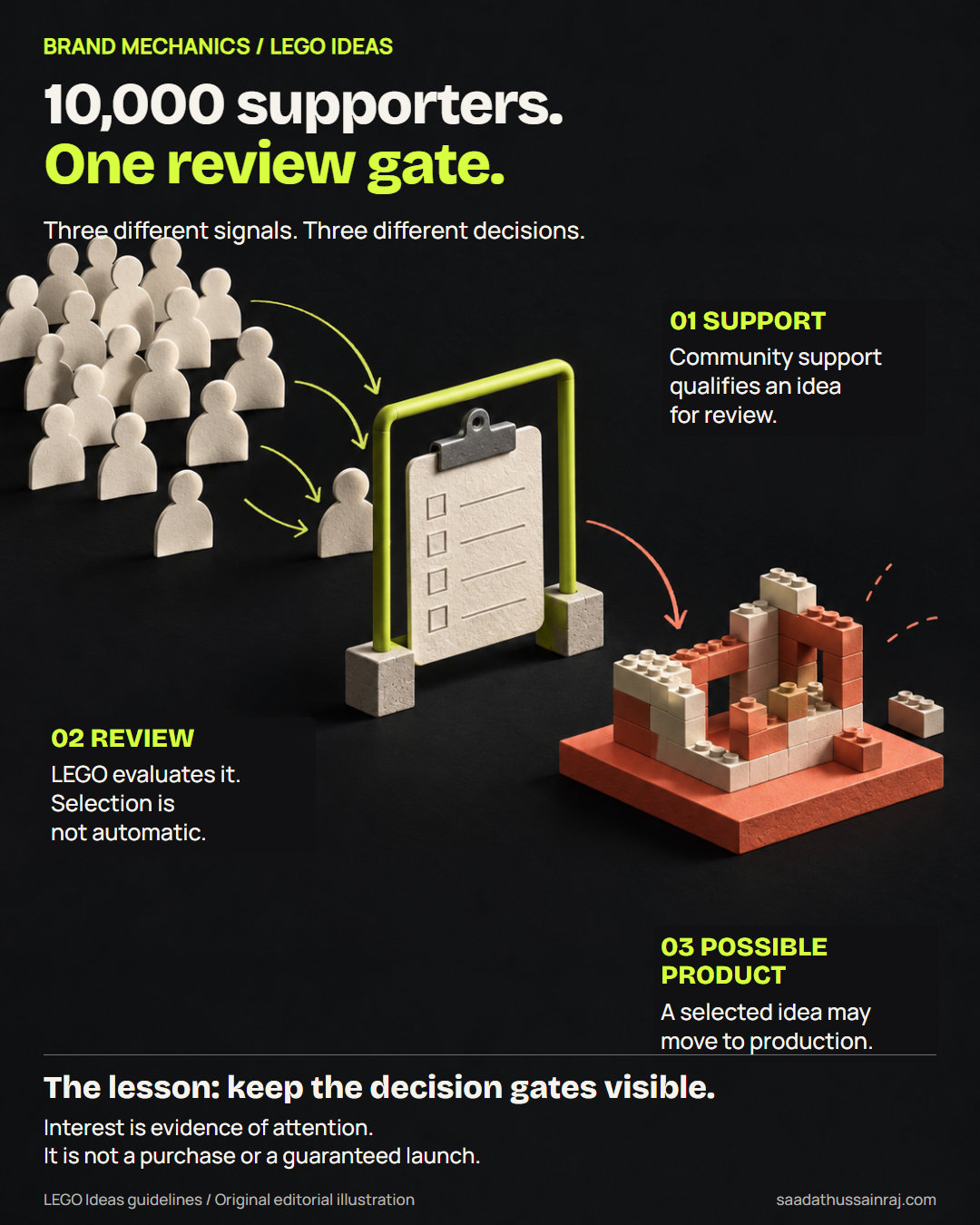
Would you launch a product because 10,000 people said they liked the idea? LEGO Ideas adds another step. At 10,000 supporters, an idea earns a review. It may become a product, but the support count is not a count of buyers. That matters whenever a marketing team uses likes or signups to decide what to launch.
Three different questions
A supporter says: I like this idea. A review asks: should we make it? A buyer says: I will pay this price for this product. All three are useful. They answer different questions. The mistake is putting the first number into a sales forecast as though the last action has already happened.
LEGO explains that the review stage can involve further information, including material that helps its team reconstruct a model, and can take several months. That is a useful reminder that the concept shown to a community is not automatically a finished commercial offer. The official page describes a review process, not a promise that every qualifying idea will launch.
Why the distinction matters in a marketing meeting
Imagine a fictional team testing a new workshop. A post attracts 500 likes and 70 people join an interest list. The team has learned that the invitation caught some attention and that some people took a further step. It has not learned how many will pay a specified price on a particular date. Those numbers are a teaching example, not LEGO results or my client work.
The next decision should match the evidence. The team might interview a few interested people, clarify the offer and test a transparent booking invitation. It should record which assumption each step addresses. A convenient engagement number should not silently become a revenue number in the next presentation.
Design the gate before celebrating the signal
- Name the action people actually took: viewed, supported, requested information or bought.
- State what the signal allows you to decide now.
- List the important questions it cannot settle, including price, delivery and repeat use.
- Define the next evidence needed and who owns that check.
This does not mean early interest is worthless. An interest signal can help prioritise learning and give a community a meaningful part in development. The problem is asking it to prove something it was not designed to measure. A useful dashboard can show momentum while keeping the next gate visible.
A practical way to use the lesson
Before approving your next launch, write three lines: What did people actually do? What can we decide from that? What do we still need to check? For the workshop above: 70 people asked for information. We can invite them to a clearly priced session. We still need to see who books before committing to a room.
My reading of LEGO Ideas is a lesson in decision design, not an estimate of its conversion rate or a claim that this process explains its commercial performance. The transferable idea is simple: celebrate the signal accurately, and make the next decision earn its own evidence.
Explore another example of how a brand promise connects with the product: IKEA and the design of its offer.
Sources and scope
LEGO official review-process explanation
Sources checked 25 October 2026. Independent marketing analysis; examples labelled fictional are not client results.