A traveler finds two apartments with similar prices and ratings. One is close to a train station; the other is beside a street full of restaurants. Which is right? A list of features may not answer the question until the traveler can picture the surrounding area.
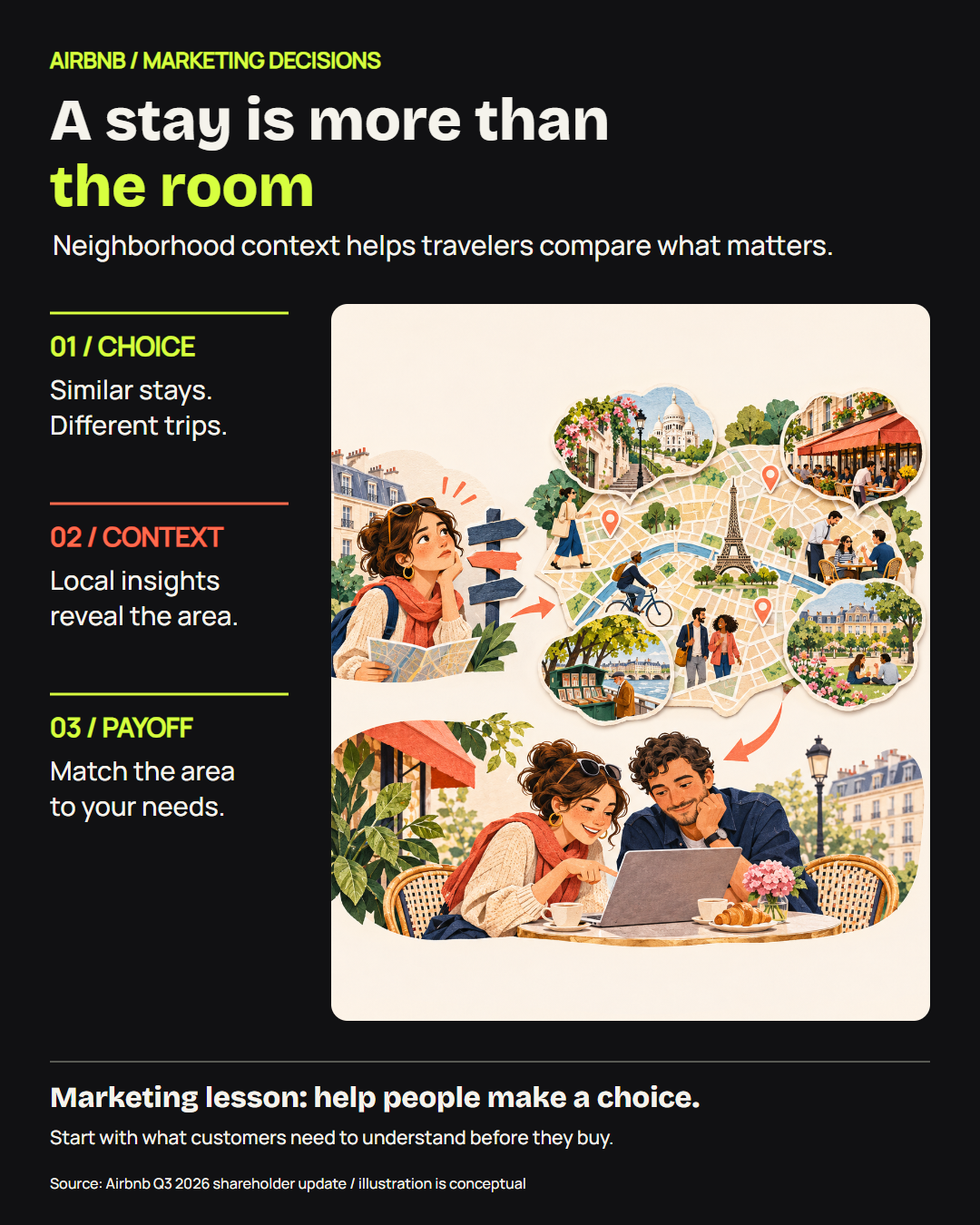
In its November 2026 shareholder update, Airbnb described neighborhood pages that bring together insights from guests and hosts and local experiences. It began with Paris and said it planned wider expansion. Airbnb reported an uplift in bookings during the initial rollout but did not publish the size, comparison design or a causal explanation in that update. This is a case about the design choice, not proof that neighborhood pages alone caused more bookings.
The decision behind the search
The real task is not simply finding an available room. A traveler may need to balance a commute, a budget, accessibility, nightlife and the preferences of a companion. A listing description can explain the home, while leaving the experience outside its door harder to judge. Neighborhood context can help people compare options against their own priorities.
Airbnb also describes a travel map and connections that let users see recommendations from people they know, with controls over what they share. That is a different source of context from a neighborhood summary. It can make planning more relevant for people who choose to use it, but usefulness depends on whether their connections have relevant experience and whether they are comfortable sharing.
What another business can borrow
Start with a decision customers struggle to make, rather than adding content for its own sake. Imagine a training provider offering two marketing courses. Course A is shorter and self-paced; Course B includes live feedback. A side-by-side guide could explain the likely time commitment, type of support and a sample exercise, so someone can pick the format that fits their week. This example is illustrative, not a measured client result.
Then ask three questions:
1. What uncertainty should the new context reduce? Look at customer questions, interviews or support requests.
2. Can a person make a better choice? Test whether they can compare realistic options and explain their reasoning; include a way to correct inaccurate information.
3. What happens after the choice? Track completion, support requests and satisfaction alongside conversion. More clicks alone do not establish a better decision.
A brief customer test can reveal confusing descriptions; it cannot establish a business lift by itself. If the decision matters enough, compare the new experience with the existing one over an appropriate period and check for unwanted effects, such as people overlooking suitable alternatives.
A useful boundary
Context builds confidence only when it stays relevant and trustworthy. Local recommendations can become stale. Reviews reflect contributors rather than every visitor. Features that use social connections need clear consent and privacy choices. A business should explain the source, offer control and make it easy to report problems.
The broader marketing lesson is to make the customer’s decision easier before asking for a conversion. The next experiment may be the missing information that lets someone decide for themselves.
Sources: Airbnb Q3 2026 results and Fall Update, 4 November 2026; Airbnb 2026 Summer Release, 20 May 2026; Airbnb total price display, 21 April 2025. Independent analysis; not affiliated with Airbnb. No lift size or causal attribution inferred.